
In May of 2012, I was three sprints into a new role at Avanade when a sprint review and retro at Traveler's Insurance fell apart. Competing consulting firms in the same room, all of us nominally on the same team. My wife Nicole was pregnant with our first son. My in-laws were living with us, displaced since a hurricane the prior August. I retreated to my car and began pouring everything I was carrying onto a yellow legal pad. What started as a way to process the pressure became a habit: the same questions rewritten with each new team, each new experience, each iteration of the same organizational patterns at a different scale. An MBA didn't move me closer. Trial and error did. Three books came out of those legal pads.
I live in Connecticut with Nicole and our two sons, Aidan and Jacob. Both are in Scouting. That is not a coincidence.
What comes after me is different from what came before.
Everything I build is an attempt to answer the same question: what does leadership look like when it's designed rather than improvised? Here is what I'm working on.
The Architecture Protocol Series
Three books built on thirty years of pattern recognition across technical organizations. Quiet Confidence covers the transition into leadership. LeadershipOS™ covers the operating system for the team. The Edge Case covers the structural tensions that don't resolve. Each one picks up where the last one leaves off.
The full series at TechnicalLeader.coach
Leadership in the AI Era
A companion to the Architecture Protocol Series on what changes about leadership specifically because of AI. Not a book about AI: a book about the leadership challenges AI surfaces and creates. In revision now.
Coming soon
LeadershipOS™ Inner Circle
A monthly physical newsletter for technical leaders. Printed, mailed, designed to be read twice: once when it arrives, once with a highlighter. The ongoing installation of everything the book series introduces.
Subscribe at LeadershipOSInnerCircle.com
The Structural Bearing Diagnostic
A 90-minute session for senior technical leaders carrying a problem that doesn't resolve. I map the structural constraint and give the leadership team a clear path forward.
Inquire at TechnicalLeader.coach
TeamOS™
LeadershipOS™ applied. A step-by-step process for building your team's operating system using the same framework as the book, designed for leaders doing it in real time with a real team.
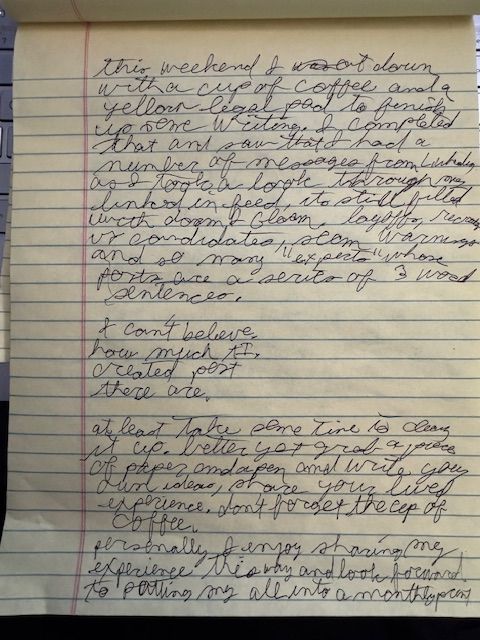
The legal pads started in May of 2012. I kept returning to the same questions: why do capable people in leadership roles keep producing the same failures? Not negligent people, not disengaged people: technically excellent people, promoted because of that excellence, now struggling inside structures that were never designed for what they were being asked to do.
I worked inside those structures for more than twenty years. I earned an MBA looking for the answer in curriculum. It wasn't there. The answer was in the accumulated pattern recognition of hundreds of sprint reviews, reorganizations, leadership team meetings, and handoffs that fell apart for reasons nobody in the room could name precisely. What I built from those legal pads wasn't a theory. It was a diagnostic.
Two moments clarified what the diagnostic was actually finding. The first was in 2008, when I was a technical lead on a project at a firm that hired a design shop to build a marketing media platform for CMO-level clients. The design won awards. The CMOs praised what they saw. The platform was never adopted. Their teams lived in spreadsheets and managed by region: a graphical map of the United States was not how any of them actually worked. The mismatch was visible to anyone who spent ten minutes with the actual users rather than the buyers. I saw it coming and had no structural position from which to say it clearly enough.
The second was during an architecture discussion with someone I had first worked with at a global consulting firm and later recruited to come work with me. Somewhere in the conversation, he said something entirely unrelated to the application we were discussing: a passing observation about how the team was working together. The idea arrived whole: the team had an operating system. It had been built by default, not by design. It was running us. That night on the train home, I took out a yellow legal pad and wrote down what was actually there: the communication patterns, the decision pathways, the unspoken rules governing how work moved through the team. That became LeadershipOS™.
The books came from that diagnostic. So do the newsletters, and the sessions I now run with senior technical leaders carrying a structural problem they haven't been able to name yet.
None of it is finished. The organizations keep producing the patterns. I keep writing.
Every article starts from a structural observation: something that is actually happening in technical organizations, named precisely enough that a reader recognizes their own situation before they finish the first paragraph. No frameworks presented in advance of the problem they solve. No tips. No productivity content.
Articles publish weekdays. The full archive is here.
Nicole and I have been building something together for a long time. The finish line has always been the same: a conversation where I tell her we are no longer at the mercy of a faceless corporation. We are not there yet. We are closer than we have ever been.
Our sons are Aidan and Jacob. Aidan is thirteen and has been in Scouting since he was a Cub Scout. He is now a Boy Scout and a den chief, which means he leads the younger kids in the same program that shaped him. Jacob is eight and a Cub Scout. The photo on this site is from a recent week on Nantucket with Aidan and his troop: one of the many moments Scouting puts in front of us.
The reason both boys are in Scouting is the same reason the books exist.
What comes after me is different from what came before.
That is not a tagline. It is the sentence my whole body of work is organized around.
The best way to reach me is email. I read everything.
I write about technical leadership on LinkedIn most days. The articles here and on LinkedIn are the same; the conversation that happens in the comments is not.
If you are a senior technical leader carrying a structural problem that hasn't responded to good design, that conversation starts at TechnicalLeader.coach.